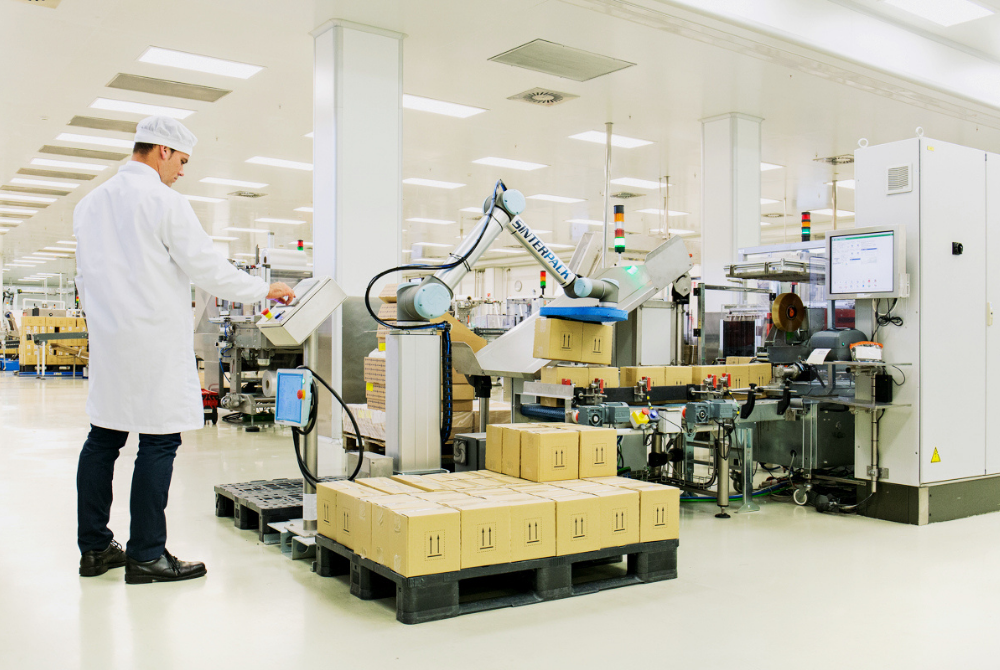
Perhaps this scenario sounds familiar to you: An employee complains of back pain. Until now, he has been responsible for palletizing at the end of the production line or in the warehouse. Shortly thereafter, he is absent from work due to illness. In the worst case, he changes careers because the physical strain is too high in the long term.
The question is: How do you protect your employees from health problems caused by heavy lifting? And almost more importantly: How do you attract and retain qualified specialists in times of staff shortages?
Collaborative robots (cobots) from Universal Robots are the ideal solution, especially for monotonous tasks and non-ergonomic movements.
But what exactly can a modern palletizing cobot do?
Companies are turning to automation to become more productive and avoid bottlenecks. Cobots perform a wide range of tasks, from loading machines to assembly. However, when it comes to palletizing, occupational safety and consistency are just as important as cost-effectiveness.
Cobots not only stack reliably around the clock, they also significantly reduce the workload for your employees. While older models were often limited to lighter loads, modern cobots offer impressive performance data:
-
High load capacity: New models such as the UR20 and UR30 can lift loads of up to 20 kg and 30 kg respectively. This means they can handle even heavy containers with ease.
-
Reach: With reaches of up to 1,750 mm, they can achieve impressive stacking heights even without additional axles.
-
Flexibility: A cobot is not limited to a specific box size. Once trained, it can pick up different products and stack them precisely according to the desired pattern.
The biggest advantage compared to traditional industrial robots is that cobots usually do not require protective fencing (depending on the risk assessment). They work directly alongside your employees, saving space. This reduces integration costs and keeps the paths clear for pallet removal.
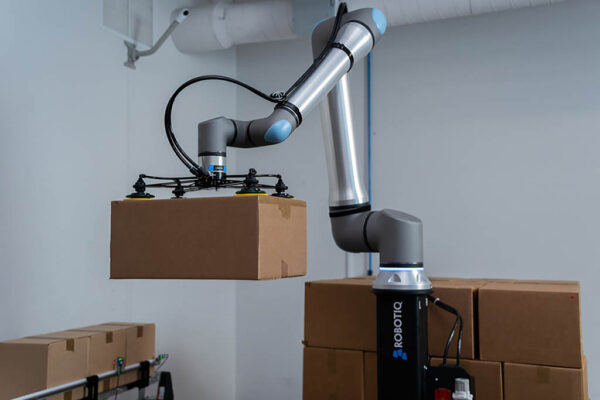
How does palletizing automation work?
A palletizing solution essentially consists of three to four components that must be perfectly coordinated with each other:
-
The robot arm: The heart of the system (e.g., UR10e, UR20).
-
Gripping technology: Vacuum suction cups or mechanical grippers, depending on the product.
-
The base: either a fixed base or a vertical linear axis (lift column).
-
The software: For easy creation of stacking patterns.
When planning such a system, the footprint, safety requirements, and desired stacking pattern are particularly important factors.
A typical scenario: You want to increase your production throughput, but manual palletizing is the bottleneck. A cobot is installed between two pallet locations. It continuously stacks products on pallet A. When this is full, it seamlessly switches to pallet B, while an employee safely replaces the full pallet A with an empty one. The process never stops.
What specific benefits does this bring?
The use of cobots often pays off faster than expected—not only financially, but also in terms of employee satisfaction.
-
Printing industry: Paper is heavy. In printing plants, employees often have to move tons of material. A cobot takes on this burden, drastically reducing the risk of back problems and ensuring that the machines can continue to run even during breaks.
-
Electronics industry: One example is the company Gustav Hensel. In the past, skilled workers were tied to palletizing. Today, a UR10 stacks around 2.5 tons of packages per 8-hour shift. The result: an optimized process and employees who are now free to perform more value-adding tasks.
Is there a simple, comprehensive solution?
Yes. You don't have to reinvent the wheel. Robotiq offers preconfigured systems that combine hardware and software with its palletizing solutions. Depending on your requirements, there are now two specialized series available:
1. The Robotiq AX Series (For maximum height and load)
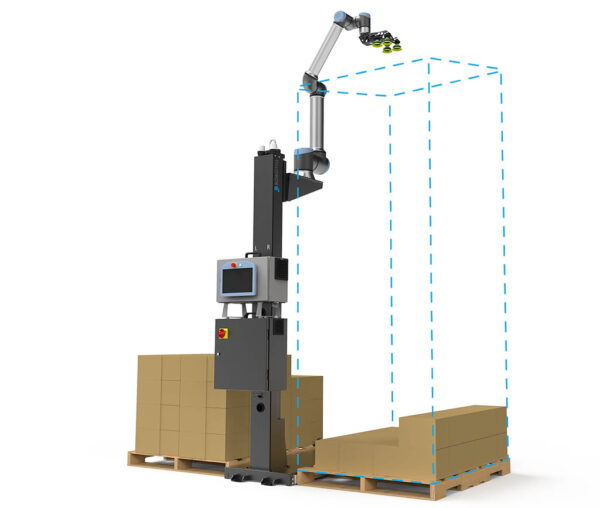
This solution features an integrated vertical linear axis. The robot moves up and down a column.
-
Ideal for: High pallets (up to 2,750 mm) and heavy loads.
-
Performance: The AX30 model can move up to 35 kg. Perfect if you need to make full use of the loading height of trucks.
2. The Robotiq PE Series (Compact and Efficient)
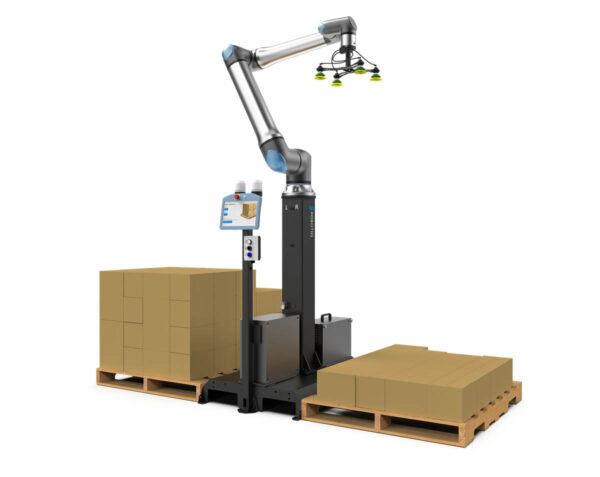
The PE series does away with the lifting axis and relies on a fixed, space-saving base.
-
Ideal for: Standard applications with limited space.
-
Performance: In combination with the powerful UR20, stack heights of up to 2,150 mm are still possible. This solution is particularly low-maintenance and easy to integrate.
The best part: both series use the same intuitive software. You simply enter the box size, weight, and orientation, select the pallet size and layout—the cobot automatically calculates the rest of the movement path.
Would you like to find out whether the AX or PE series is better suited to your production?