
General FAQs
The kit includes the ASIO X drone, the remote control with integrated display, 3 flight batteries, a charger with matching adapters, two sets of spare propellers, a tool set (including spare cable ties and T6 screwdriver), a safety vest, and a QR code for access to the Flybotix portal and all documentation.
Yes. Thanks to the integrated IMU, radar sensors, VIO cameras, and optically mounted sensors, the drone determines its position and movement in confined spaces completely independently. This data replaces GPS for reliable stability.
Yes, under ideal conditions. At full brightness, the flight time is reduced by about 2 minutes. External factors such as wind can further affect the time, but under normal operating conditions, 20 minutes is a realistic estimate.
Yes. It is equipped with a forward-facing, swiveling LiDAR (opening angle: 106° horizontally, 86° vertically). The LiDAR's gimbal can be tilted 90° up and down. For seamless coverage of the entire space, the pilot simply controls the drone through the environment.
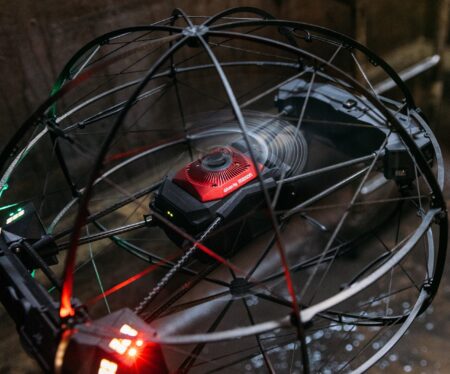
Hardware: Integration of the swiveling LiDAR, additional VIO cameras, and radar for better stability in poor visibility conditions, increase in light output from 8,000 to 40,000 lumens, integrated gas sensor, and a protective cage that is three times more robust.
Software: Higher mapping accuracy and new AI and cloud features for powerful post-processing.
The dimensions are: length 425 mm, height 305 mm, width 406 mm.
Cameras & Payload
The kit includes the ASIO X drone, the remote control with integrated display, 3 flight batteries, a charger with matching adapters, two sets of spare propellers, a tool set (including spare cable ties and T6 screwdriver), a safety vest, and a QR code for access to the Flybotix portal and all documentation.
Yes, because the fisheye effect helps the pilot navigate the drone better. However, the images can be easily corrected in our post-processing software ASIO Explore.
Yes. While the remote control only displays a color thermal image, the radiometric temperature data is stored on the SD card and can be read accurately in ASIO Explore/Connect.
Yes, every ASIO X is equipped with a gas sensor in the rear module as standard.
Additional loads of up to 100 g are possible. However, this requires prior consultation and approval by Flybotix, as adjustments to the control system may be necessary. Unauthorized modifications will void the warranty.
Software: Higher mapping accuracy and new AI and cloud features for powerful post-processing.
remote control
The Herelink controller displays a 720p live image. The video stored on the SD card is recorded in Full HD (1080p).
Yes, the image can be transferred to a Windows PC (via USB cable and Flybotix app) or an HDMI screen (via adapter). Wireless transmission via an RTSP-compatible player is also possible.
No, we currently only support the 4:3 format, as it provides more vertical image information. A 16:9 image would simply be a crop of the original 4:3 image.
What frequency does the control system operate on?
That depends greatly on the environment. In metal containers, the structure often acts like a waveguide; here, tests were conducted over 1.2 km. In rock or concrete tunnels, signals are absorbed more strongly (range approx. 200–250 m). A line of sight is essential; we offer range extenders as an option.
Data & Software
All flight data is stored on an SD card in the drone. After the flight, the card is removed and read on a PC. We recommend using a second card (FAT32) so that you can continue flying immediately.
At least an Intel i7 processor and 16 GB RAM.
Yes, a special photogrammetry mode can be activated on the controller. Alternatively, images can be extracted directly from the 4K video (approx. every 1–2 seconds) for use in modeling.
The precision of 3D object measurements is 1%. Point-to-point measurements on the map vary between 2% and 14% depending on the environment, as the positioning of the drone (precision 1–7%) forms the basis.
Yes. ASIO Explore only needs to connect to the Internet once a month for license verification. For high-security areas, we also offer one-year offline licenses.
flight environment
No. It is protected against light dust and drops, but is not suitable for water jets or diving. One advantage: thanks to its low weight, it causes hardly any splashing when flying over water.
Yes, its radar sensor technology makes it particularly suitable for dusty environments where optical sensors fail. As long as the pilot can see where he is flying on the screen, the ASIO X can be used.
Possible, but it is not designed for this (no GPS, low wind tolerance). Please contact us before outdoor use for best practices.
3 m/s. At this value, the drone is already at the limit of its tilt angle and can hardly move against the wind. We advise against flying in windy environments.
The minimum diameter is 800 mm. It is important to maintain constant forward movement to avoid turbulence. The drone can hover stably without any problems from a diameter of 1.5 m.
No, such certification is hardly feasible for drones of this type. Despite the necessary ventilation or "hot work" permit, it offers enormous advantages over personnel access (no scaffolding, time savings, safety).
assistance systems
No. However, the "Rewind" function allows the drone to automatically retrace the last 5 meters of its flight path, which is usually sufficient to restore the signal.
Not yet. The sensors are highly directional, so very thin obstacles could be overlooked. The protection serves as an aid. LiDAR-based, complete collision protection is planned for the future.
Yes, if it makes sense in the environment. For example, Velocity Lock, Tube Lock, and collision protection can work simultaneously.
Battery & Maintenance
A battery can be charged about 60 to 100 times before a noticeable loss of capacity occurs. After that, it can still be used for shorter flights.
The battery management system takes the age of the battery into account and adjusts the display accordingly. Nevertheless, pilots should always keep an eye on both the flight time and the percentage display.
A completely empty battery takes approximately 70 minutes. With a remaining charge of 20%, it takes about 45 minutes.
Yes, this must be set manually on the charger. In storage mode, the batteries will last for several months without any problems.
End users are permitted to replace the protective cage and propellers. Any other work may only be carried out under the supervision of certified trainers.
All manufacturing defects are covered for 12 months under normal use. Damage caused by operating errors or use outside the specifications is excluded.
Yes, training is mandatory for all new customers and pilots and is usually carried out directly by us.

Was your question not listed?