

For many production managers, the idea sounds like an unattainable dream: using only as much material, time, and personnel as absolutely necessary—while remaining flexible enough to respond immediately to market changes.
But this is not a utopian dream. It is the principle of lean production. The goal is radically simple: value creation without waste. Every movement, every transport route, and every gram of material that does not directly contribute to the value of the product is eliminated. The result is a massive reduction in costs due to scrap, unnecessary warehousing, and rework.
In this article, we show you why lean production is vital for Switzerland as a business location and how you can master the transition in practice.
What are the specific benefits of lean production?
"Lean" does not mean cutting back on essentials, but rather on superfluous items. The focus is on three factors that reinforce each other:
-
Productivity: Combining similar processes shortens throughput times.
-
Quality: Less complexity means fewer sources of error.
-
Flexibility: Adaptable capacities also enable small batch sizes (high mix/low volume).
For high-wage countries, this approach is key to keeping the "Swiss Made" quality promise competitive. Eliminating waste drastically reduces unit costs.
Best practice: The transformation of Albrecht JUNG GmbH
Albrecht JUNG GmbH, a specialist in building technology, shows how to make a successful transition. Under the leadership of production manager Mario Schäfer , the company underwent a change in perspective: away from a focus on products and toward process optimization.
This means that the focus is no longer on what is being manufactured (e.g., switch A or socket B), but rather on how it is manufactured. Similar processes are bundled together, regardless of the end product. The conversion of a production line takes place in three proven phases:
Phase 1: Building understanding
Before machines are moved, minds must be changed. The "lean team" explains to the workforce that "lean" does not mean job cuts, but rather the elimination of annoying, unnecessary steps.
-
Motto: "You don't need an entire tree trunk to make a toothpick."
-
Important: Employees develop their own suggestions. Those who develop the solution themselves will also support it later on.
Phase 2: Sequencing & Simulation
Ideas must be practical. Workstations are replicated and tested in workshops using special equipment. Which hand movements are required where? How does the material flow? Only when the optimal solution has been found is it implemented in the actual production line.
Phase 3: Keeping things running (CIP)
Lean is not a project, but an attitude. To ensure acceptance, dialogue with employees must be ongoing. Otherwise, unresolved minor issues can quickly lead to rejection of the new system.
Cobots: The turbocharger for your lean production
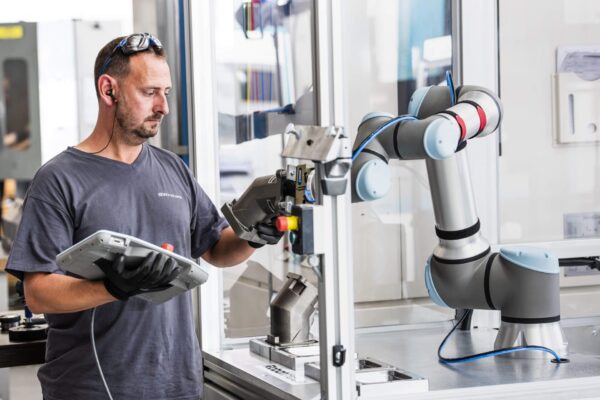
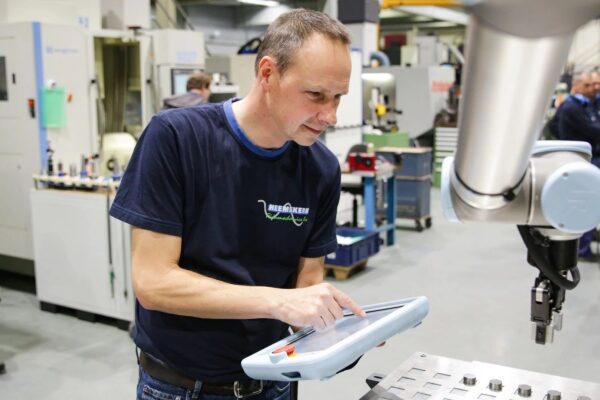
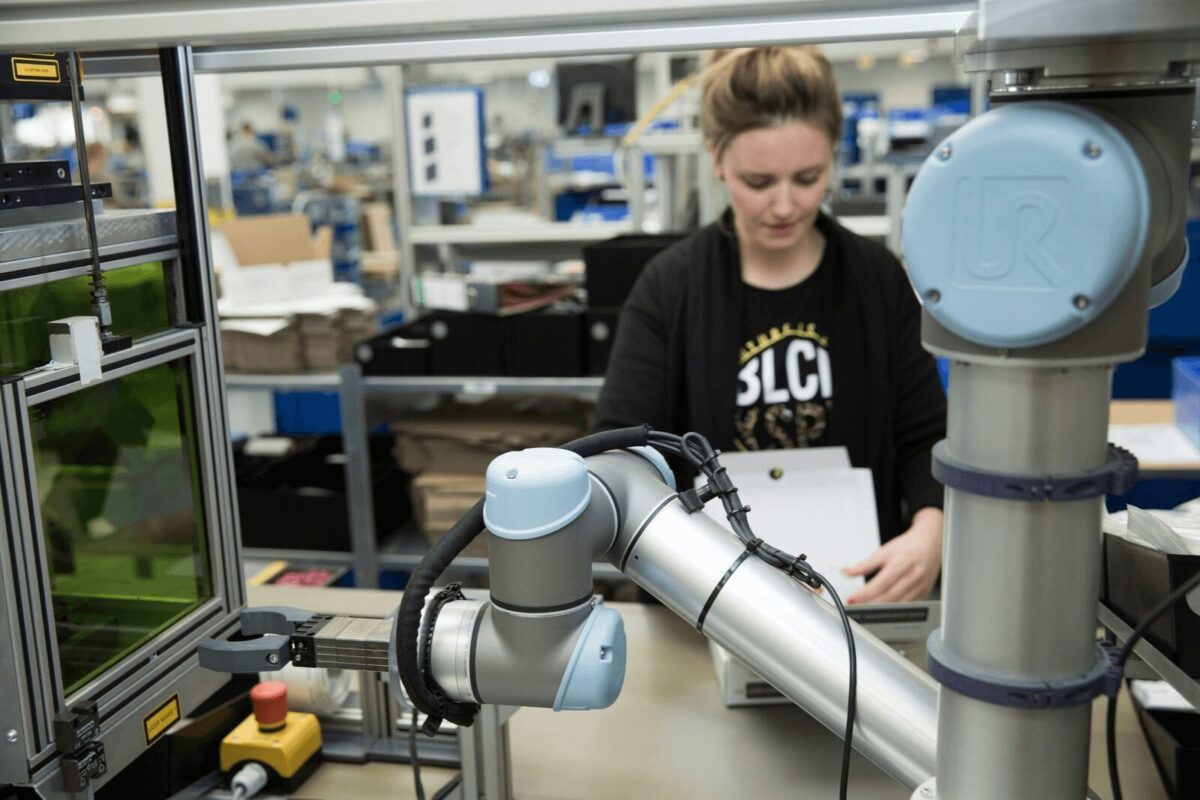
Lean production is the philosophy, cobots are the tool. Albrecht JUNG now has eight collaborative robots from Universal Robots in use. They fit perfectly into the lean concept because they come into play precisely where humans make mistakes or tire:
-
Eliminate waste through rejects: Cobots work with maximum repeat accuracy. Where humans lose concentration after 6 hours, the cobot continues to work with precision. Less waste means less garbage.
-
Eliminate waste caused by waiting times: Cobots can work around the clock and operate processes with "clockwork precision."
-
Relieving the burden on employees: The cobot takes over monotonous screwing or gripping tasks, while humans perform value-adding control tasks.
An employee reports from practical experience:
“I used to have to tighten the screws by hand. That was often fiddly work because they are quite small—sometimes I slipped while doing it. The work has also become safer for me thanks to the UR3 cobot. I also save valuable time per work step—and can therefore assemble significantly more parts.”
The 3 success factors for your transition
To ensure that optimization does not come to nothing, expert Mario Schäfer recommends the following cornerstones:
-
Support from leadership: Management must provide resources and actively exemplify change.
-
Interdisciplinary team: The lean team needs a hands-on mentality and decision-making authority to change things immediately.
-
On-site involvement: Workshops take place in the hall, not in the conference room. The works council and the workers are involved from the outset.
Conclusion
Lean production combined with cobots is the most effective way to increase profitability. They minimize rework, reduce material costs, and relieve your employees of unergonomic tasks.
Would you like to know where the greatest "waste" in your production process lies that a cobot could eliminate?