
Companies are increasingly considering mobile cobot solutions. Especially when dealing with frequent product changes, small batch sizes, and tight delivery times, cobots must be flexible and effective. A mobile base makes this possible. But the question remains: What solutions are available, and at what point does such a solution become worthwhile?
Here you'll find answers to these questions.
Why are mobile cobots becoming more and more popular?
Mobile cobots provide the answers to questions that arise every day on the production floor:
- How can we use the machines even more efficiently?
- How can processes be automated flexibly and effectively?
- How can even the smallest businesses be globally competitive?
Cobots are lightweight robots. That’s why collaborative robots aren’t limited to static applications. AUR3e, for example, weighs just 11 kg. This makes flexible use a breeze. The cobot can then be viewed as a tool in a toolbox that is always used wherever it is needed. But that’s not all. They also have a very small footprint. Conventional industrial robots quickly reach their limits due to their space requirements. The situation is completely different with cobots. They can work reliably even in tight spaces. Because of this compactness, cobots are ideal for mobile robotics.
How can cobots be made mobile?
We’d like to introduce three ways you can make your cobot mobile. These three solutions are: our integrators, who can assist you; solutions from the UR+ product line; and custom designs.
Implementation with Our Integrators
Our network of integrators supports you as a user and develops the right application—even if you want to make your cobot mobile.
UR+ for Greater Mobility
The UR+ solutions also include several options for making your cobot mobile. We will gradually make these solutions available here in Switzerland as well.
Your own implementation
There are companies that like to develop their own mobility solutions for cobots. One example is Hofman Glastechnik GmbH. They have made their cobots mobile through a design of their own.
Optimizing Production with Mobile Cobots
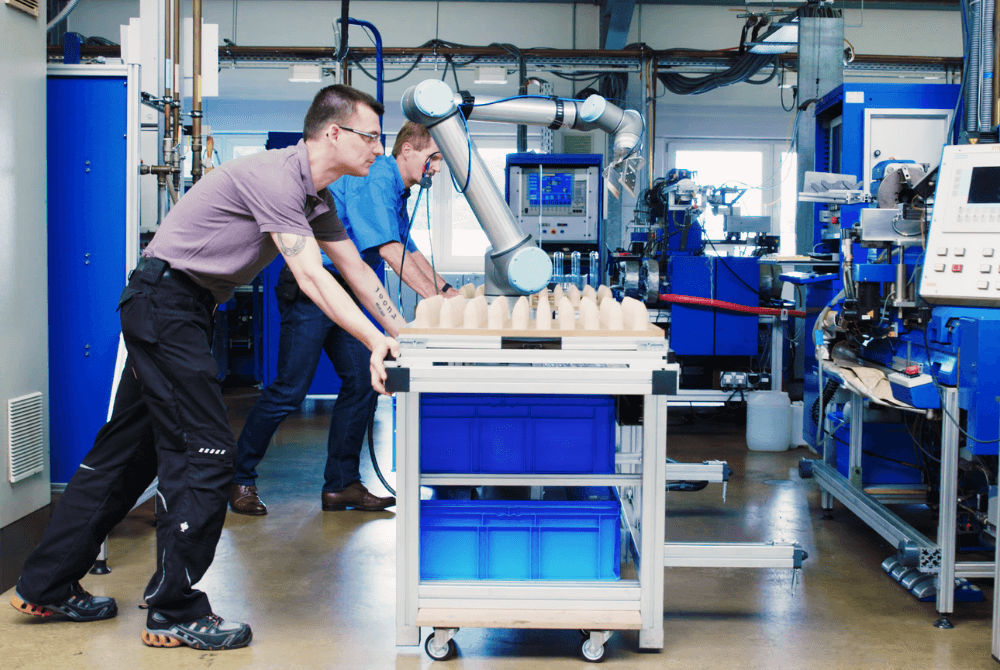
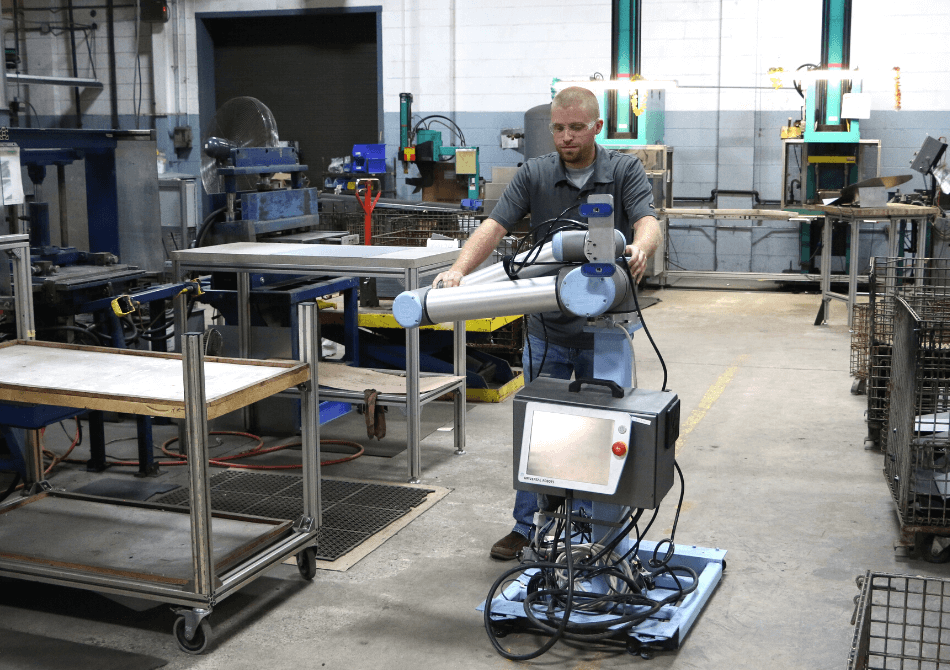
Scott Fetzer has been using mobile cobots in its manufacturing operations since 2015. The cobots are mounted on wheeled bases. This mobility is necessary because the product mix is diverse and production volumes are low. Depending on the need, the cobots can therefore be deployed throughout the entire manufacturing process. Applications range from cutting on a cutting press to forming, folding, and assembling electrical components. Thanks to the mobile robots, Scott Fetzer has been able to optimize its production by 20 percent.
Mobile cobots help your skilled workers
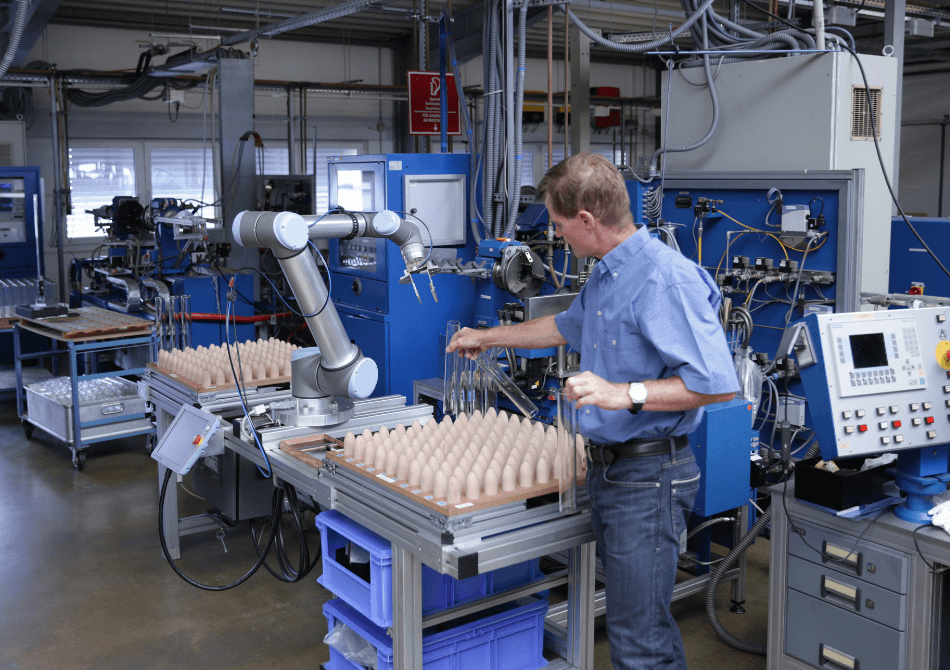
Hofmann Glastechnik GmbH also uses mobile cobots. The four cobots are intended to make better use of skilled workers and further optimize processes.
Two of the cobots feed several PLC-controlled glass lathes for up to 11 hours a day. Hofmann has developed its own mobile device that allows the cobots to be easily moved between machines. Employees are enthusiastic about this solution because it makes their workflows significantly easier.
Discover Mobile Potential
When companies use cobots in a mobile setting, even more opportunities arise to fully leverage their potential. You should always ask yourself whether a mobile version might be a better fit for your application. If the cobot isn’t being used to its full capacity in a particular application, you should definitely consider a mobile solution.