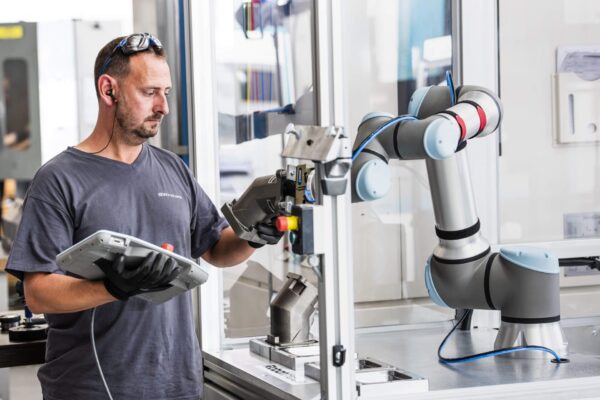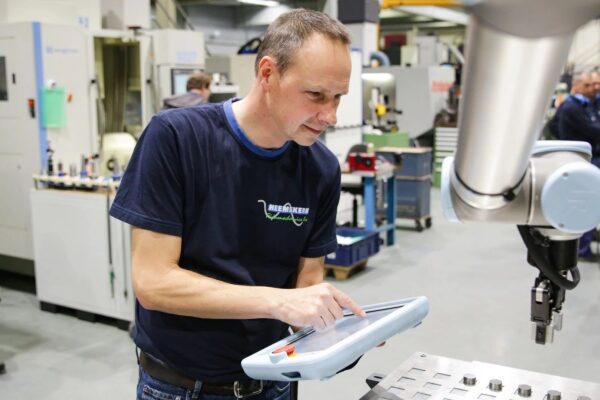


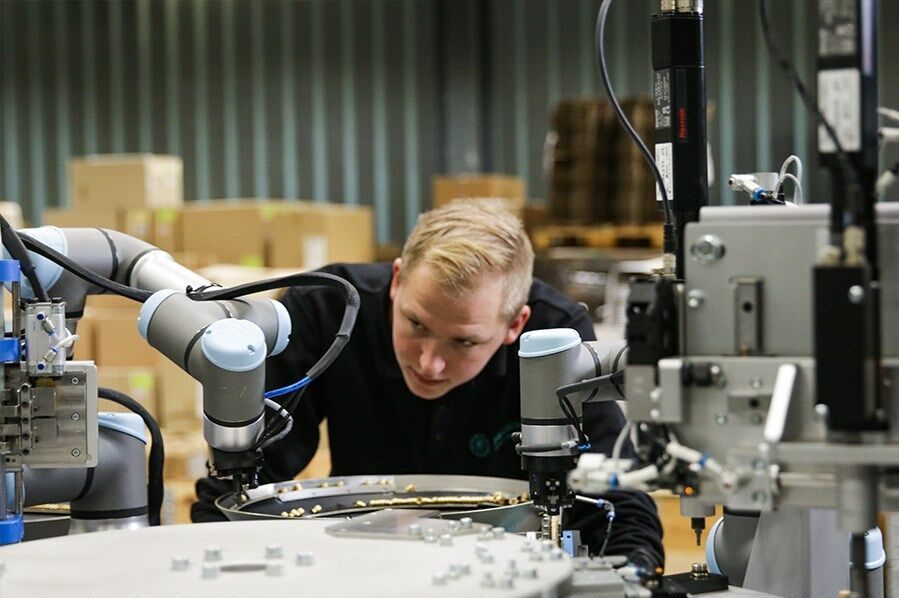
The manufacturing landscape has changed dramatically. Companies today face a "perfect storm" of two major challenges:
-
The shortage of skilled workers: Baby boomers are retiring and taking their experience and knowledge with them. At the same time, fewer qualified workers are coming through. Studies (e.g., by Deloitte) predict a massive shortage of skilled workers in the coming decade.
-
Increasing demands: Today's customers expect real-time availability, the highest quality, and falling prices—all in a volatile global economy where supply chains can quickly break down.
The answer to this dilemma is automation. But we're not talking about expensive, fenced-in industrial robots. We're talking about cobots (collaborative robots) that break down barriers and make automation possible for businesses of all sizes.
Here are 5 ways cobots can help you stay competitive.
1. Productivity: The colleague who never gets tired
Employees get tired. That's human nature. Especially when performing repetitive or ergonomically unfavorable tasks, performance declines over the course of a shift and the risk of injury increases. A cobot works consistently. It takes over monotonous "handling" tasks while your employees use their cognitive abilities for value-adding tasks.
The result in practice: HIHHT (Hyundai Induction Hardening Heat Treatment) was struggling with errors caused by fatigue during manual machine loading. After installing two UR10 cobots, the error rate fell from 0.03% to 0.01%, while production efficiency increased by 31%. Interestingly, the growth enabled the company to hire two additional employees instead of reducing its workforce.
2. Profitability: Small savings, big leverage
The goal of every company is profitability. Cobots reduce manufacturing costs through consistent cycle times and minimized waste. The leverage here is enormous: a study by research firm Smithers Pira found that reducing production costs by just 1% can lead to a profit increase of up to 34%.
Cobots are precision tools. They eliminate unplanned downtime and ensure that you protect your margins, even when price pressure on the market increases.
3. More satisfied employees: Retaining skilled workers instead of losing them
A common misconception is that robots destroy jobs. The reality shows the opposite: cobots make jobs more attractive. Nobody wants to spend eight hours a day sorting parts ("dull, dirty, dangerous"). If you expect your employees to do such tasks, you will have difficulty retaining them.
Automation as a job engine: A McKinsey study confirms that automation facilitates the recruitment and retention of employees. Why? Because the use of technology enhances the value of the work. Employees are transformed from "parts loaders" to "robot operators." This creates better working conditions and opportunities for development.
4. Quality: The goal of "zero defects"
Today's customers no longer forgive mistakes. A cobot guarantees consistency. It tightens the 500th screw with exactly the same torque and at the same angle as the first.
The result in practice: Tool manufacturer RUPES committed itself to the goal of "zero defects." They sought a solution to remove human variability from the process. By using cobots, RUPES was able to drastically reduce waste and save raw materials. Quality is now 100% reproducible, and the environment is protected thanks to less waste.
5. Flexibility: Ready for any market situation
In an uncertain economy, flexibility is the most important currency. Rigid automation (a robot that can only do one thing) is a risk. Cobots are flexible all-rounders.
-
Loading machines in the morning, palletizing in the afternoon? No problem.
-
Product A today, a small batch of product B tomorrow? The changeover often takes only minutes.
Cobots enable you to adapt your production to demand almost in real time. Even heavy tasks or complex material handling are no longer an obstacle today.
Learn more about how flexible cobots are in use.
Conclusion: Automation is no longer a luxury
Ten years ago, cobots were a competitive advantage for early adopters. Today, they are a necessity for keeping production domestic and remaining profitable. Those who do not invest now risk falling behind.
Would you like to see how a cobot can increase your productivity without limiting your flexibility?